WILSONELECTRONICS.COM, WILSONPRO.COM AND ZINWAVE.COM ARE NOW WILSONCONNECTIVITY.COM
Six Ways to Solve In-Building Wireless: How to Figure Out Which One You Actually Need
July 15, 2026
A practical guide to Wi-Fi, passive DAS, hybrid DAS, private cellular, and everything in between.
By Payam Maveddat, General Manager - EnterpriseWalk into almost any building and pull your phone out. If the bars drop, the video call freezes, or the guest Wi-Fi boots you off halfway through a meeting, you've just bumped into one of the most overlooked pieces of modern infrastructure: in-building wireless.
I've been designing these systems for a long time, and the conversation has changed. It used to be that a building owner could shrug and say, "That's Wi-Fi." That doesn't cut it anymore. People expect their cell service to work everywhere. First responders need dedicated radio coverage inside your walls. Hospitals run mission-critical equipment over cellular. Factories depend on private networks to keep automated guided vehicles and robots moving. And somewhere, a facilities manager is staring at a code-compliance notice wondering why the building failed a public-safety radio test.
The tricky part? There isn't one right answer. The best in-building wireless architecture depends on the venue, the users, and what the network has to do. Pick wrong and you either overspend on capacity you don't need or underspend and end up replacing the system in a few years.
Here's the framework I walk customers through:
How big is the venue, and how dense is the usage? A small office isn't the same animal as a 60,000-seat stadium.
Who are the users? Public visitors, private employees, connected devices, or all three?
How critical is the traffic? Casual web browsing lives in a different universe than operational technology and IoT systems that cannot afford unreliable connections.
Does the building need first-responder radio coverage? Local codes and the Authority Having Jurisdiction may require an emergency responder communication enhancement system (ERCES), often implemented as a public-safety DAS. That requirement is separate from Wi-Fi and commercial cellular coverage.
What's the growth curve? If you're adding devices, tenants, or use cases quickly, you need headroom.
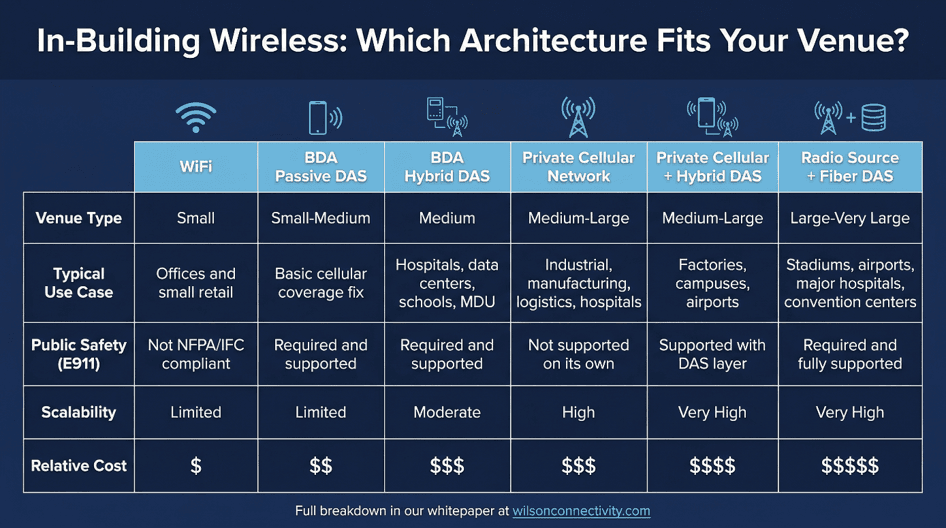
Once you've got those answers, six architectures roughly map to where you land.
Option 1: Wi-Fi - great for local data access, but not a complete wireless strategy
Wi-Fi is affordable, familiar, and effective for offices, small retail locations, and other spaces where people mainly need local network access, email, web browsing, and video calls. With the right design, it can deliver strong throughput across laptops, phones, and connected devices.What it is not: a substitute for commercial cellular coverage or a code-compliant public-safety radio system. Performance can also vary with congestion, handoffs, device behavior, and network design. If Wi-Fi is your only connectivity strategy, you may still have gaps for carrier voice, visitor devices, and first-responder communications.
Option 2: Passive DAS - use outdoor cellular signal in smaller and mid-size buildings
A passive DAS uses a bi-directional amplifier (BDA) to enhance available outdoor commercial cellular signal and redistribute it inside through coaxial cable and indoor antennas. It is often the most practical way to address dead zones in offices, retail buildings, multifamily properties, and other small-to-medium venues.Passive DAS is a coverage solution, not a source of new carrier capacity. Results depend on the strength and quality of the outdoor signal, the building layout, and the system design. A commercial passive DAS also does not satisfy public-safety radio requirements unless a separate, purpose-built public-safety system is designed and approved for that use.Option 3: Hybrid DAS - extend macro signal across larger or more complex spaces
Hybrid DAS starts with the same macro-signal approach as passive DAS but uses fiber to carry RF farther through the building before distributing it from remote units. That makes it a strong fit for hospitals, data centers, university housing, K-12 schools, multi-dwelling units, and multi-tenant office or retail properties where long cable runs or complex floor plans make an all-coax design less practical.You gain reach, flexibility, and a clearer path to expansion, but the system still depends on the available outdoor cellular signal. You are extending commercial carrier coverage, not automatically creating new capacity or meeting public-safety radio code.Option 4: Private cellular networks - for mission-critical enterprise operations
If you run a factory, university, hospital, port, mine, logistics hub, or smart-city deployment, public cellular and Wi-Fi may not provide the control your operations need. Private LTE or 5G can deliver defined quality of service, more predictable performance, strong security, and the ability to segment traffic across IT, operational technology, and IoT environments.The biggest advantage is control: you decide who connects, how traffic is prioritized, and how the network supports critical applications. But private cellular does not replace public-carrier coverage for employees and visitors, and it does not replace a dedicated public-safety radio system where one is required.Option 5: Private cellular plus hybrid DAS - when one network cannot serve every user
Some venues pull double duty. A factory may need a private network for automation and operational systems while employees, contractors, and visitors still need service from their own cellular carriers. The same is true for campuses, airports, and larger healthcare sites.Combining private cellular with hybrid DAS gives you both layers: controlled enterprise connectivity on the private side and multi-carrier commercial coverage on the DAS side. It costs more than either architecture alone, but it is often the right call when one network cannot stretch across both use cases. If the local jurisdiction requires first-responder radio coverage, a dedicated ERCES or public-safety DAS layer must still be designed into the solution.Option 6: Radio source plus fiber DAS - the high-capacity backbone for major venues
Stadiums, airports, major hospitals, malls, and convention centers face a different problem: thousands of users competing for service at the same time. These environments often need dedicated radio sources, such as carrier base stations or small cells, feeding an active or fiber DAS that distributes signal throughout the venue.This is the highest-capacity and most scalable option in the stack. It also carries the highest cost and typically requires the most coordination with carriers and other stakeholders. A fiber DAS can distribute commercial cellular, private network, two-way radio, or public-safety frequencies when it is specifically engineered, sourced, and approved for those services; compliance is not automatic.A simple path to picking one
Start with venue size and density. Small office or shop? Wi-Fi plus targeted commercial cellular coverage may be enough. Mid-size enterprise, healthcare, or education facility? Passive DAS, hybrid DAS, or private cellular may fit, depending on whether the main problem is coverage, reach, security, or operational control. Large campus, airport, or stadium? You are likely looking at a combined architecture or a dedicated radio source feeding a fiber DAS.Then pressure-test the choice against your user mix. Mostly public users doing everyday work? Wi-Fi, passive DAS, or hybrid DAS may fit. Heavy on IoT, automation, or regulated data? Move toward private cellular. Very high user density or carrier-capacity requirements? Move toward a radio-source and fiber-DAS architecture.
Treat public safety as a parallel requirement, not an assumed feature of the commercial network. If local code or the AHJ requires an ERCES, engage them early and design a dedicated public-safety layer. Wi-Fi, commercial DAS, and private cellular are not substitutes unless the system is specifically engineered and approved for public-safety service.
Finally, think about growth. If your device count, tenant count, or use cases are climbing quickly, bias toward architectures that can scale without forcing you to replace the entire system.
The Shortcut
Most buildings do not need the most expensive architecture, and most cannot rely on the simplest option alone. The right answer usually lives somewhere in the middle, which is where we spend most of our time helping customers land.Wilson Connectivity covers the full spectrum: entry-level commercial coverage enhancement through WilsonPro, passive and hybrid DAS, private 5G platforms, active fiber DAS, and purpose-built public-safety solutions. The goal is not to sell the most expensive system. It is to put the right architecture in place today, with a clear path to grow without ripping out what you have already built.
Download the full whitepaper for a side-by-side comparison of all six options.
Featured & Trending Now
Six Ways to Solve In-Building Wireless: How to Figure Out Which One You Actually Need